Guide
TPMS Warning Light: What It Means and What to Do
That amber horseshoe with an exclamation mark isn't decorative. Here's the calm UK driver's playbook — when to keep going, when to stop, and when to call a fitter.
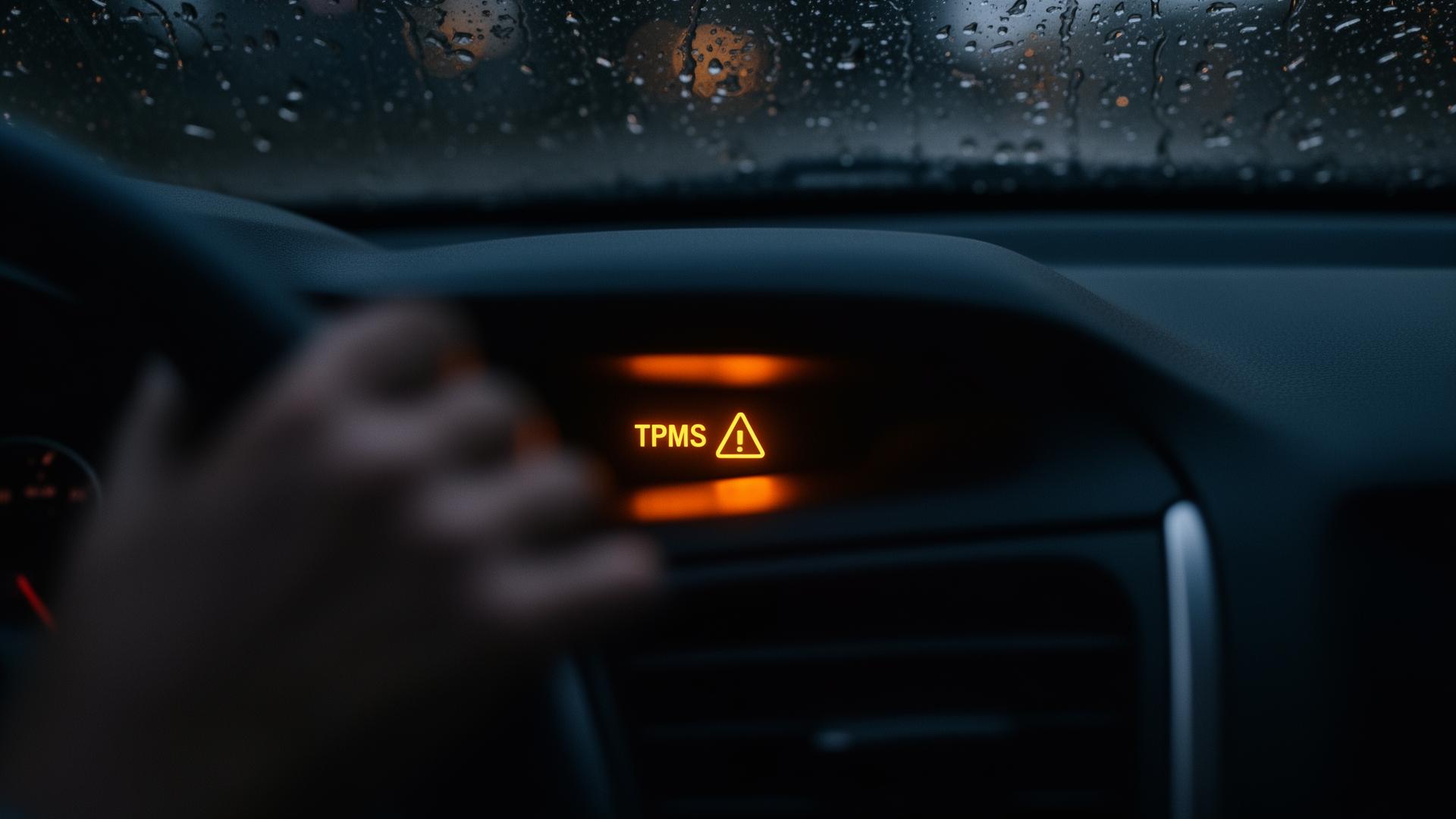
What the TPMS light actually means
TPMS stands for Tyre Pressure Monitoring System. UK and EU law has required it on every new passenger car sold since November 2014. The familiar amber symbol — an open horseshoe with an exclamation mark inside — comes on when one or more tyres are at least 25% below the recommended pressure, or when the system itself has a fault.
Two warning behaviours matter:
- Solid amber — at least one tyre is under-inflated. Reduce speed, check pressures soon.
- Flashing for ~60 seconds, then solid — the TPMS system itself has a fault (failed sensor, dead sensor battery, missing wheel). The system can't monitor pressure until fixed.
TPMS warning light on: is it safe to keep driving?
Short answer: get to a safe stop, then check. A 25% under-inflated tyre runs hotter, flexes more in the sidewall, increases stopping distance and burns more fuel. At motorway speed it can fail catastrophically within 50–100 miles.
If the tyre looks visibly flat or you can hear hissing — stop. Don't try to "make it home". Call a mobile fitter or recovery. If the tyre still looks normal, drive at moderate speed to the nearest petrol station and check all four pressures.
Common reasons the light comes on
- Cold weather. Tyre pressure drops about 1 PSI for every 10°C fall. A car parked overnight in November can lose 3–4 PSI by morning — enough to trip TPMS without any leak.
- Slow puncture. A small nail or screw causes a gradual drop over hours or days. Often the tyre still looks round but is 6–10 PSI low.
- Dead sensor battery. Direct TPMS sensors have a sealed battery that lasts 5–10 years. After that, the sensor goes silent and the system flags a fault.
- Sensor knocked off during a tyre change. A careless tyre bay can damage the sensor stem when breaking the bead.
- Wrong winter wheels. Switched to a second set of alloys without TPMS sensors? Light will be on permanently until sensors are fitted and programmed.
- Aftermarket sealant. Tyre sealant from emergency kits can clog the sensor port. Tell your fitter — most can clean and re-seat it.
How to reset the TPMS warning light
First, fix the underlying cause — inflate to the correct pressure or replace the faulty tyre/sensor. Reset method depends on which system you have:
- Indirect TPMS (uses ABS sensors — most VW, Renault, Vauxhall pre-2018): drive 10–20 minutes above 25 mph, or press the TPMS reset button on the dash / in the menu.
- Direct TPMS (sensor inside each wheel — BMW, Mercedes, Audi, most premium): many relearn automatically within 10 minutes of driving. Others need a menu reset (BMW iDrive → Vehicle → Tyre Pressure → Reset) or an OBD/TPMS programming tool.
If the light returns within a day, you almost certainly have a slow puncture or a failing sensor — not a "false alarm".
Correct tyre pressures — where to find them
Don't guess. Manufacturer pressures are printed on a sticker in one of these spots:
- Driver's door jamb (most common)
- Inside of the fuel filler flap
- Glovebox lid
- Owner's handbook
Check cold — first thing in the morning, before driving more than a mile. Pressures rise 3–5 PSI when tyres are warm.
TPMS sensor cost in the UK (2026)
- Universal programmable sensor: £25–£45 each
- OEM sensor (BMW, Audi, Mercedes, Tesla): £55–£110 each
- Programming and fitting: £15–£25 per wheel
- Full set of 4 fitted and programmed: typically £160–£360
When to call a mobile fitter
Call rather than drive if:
- A tyre is visibly flat or losing air faster than you can inflate it.
- The TPMS light came on with a bang, vibration or steering pull.
- You're on a motorway hard shoulder — never attempt repairs in a live lane.
- You've added air twice in 48 hours and it keeps going down.
Book a mobile tyre fitter — most jobs across London and major UK cities are completed in 35–60 minutes, including TPMS reset on the way out.
TPMS warning light FAQs
Is it safe to drive with the TPMS light on?
Only briefly, and only at reduced speed. The light means at least one tyre is 25% below the recommended pressure. Drive to the nearest petrol station or safe stop, check pressures, and re-inflate. If a tyre is visibly flat or losing air fast, stop and call a mobile fitter.
Why is my TPMS light on but tyres look fine?
Cold weather drops tyre pressure by ~1 PSI per 10°C, so a chilly UK morning can trigger TPMS even with no leak. Other causes: slow puncture from a small nail, a failed TPMS sensor battery (5–10 year life), or a sensor knocked off during a tyre change.
How do I reset the TPMS light?
First, inflate all four tyres to the correct pressure (driver's door jamb or fuel filler flap). For indirect systems, drive 10–20 minutes above 25 mph or press the reset button. For direct sensors, some cars relearn automatically; others need a menu reset or an OBD tool.
How much does a TPMS sensor cost in the UK?
Universal programmable sensors cost £25–£45 each. OEM sensors (BMW, Audi, Mercedes) are £55–£110. Fitting and programming adds £15–£25 per wheel. A full set of four typically lands at £160–£360 fitted.
Related reading
Light still on?
Mobile tyre fitters with TPMS tools — across London and the UK, 24/7.
Get a quote in 60 seconds →Mobile tyre fitting in your area