Emergency Guide · 12 min read
Flat Tyre in London: Causes, Emergency Steps & Mobile Fitter Guide
You're on the A406 in the rain, the steering pulls, and a flapping noise starts under the wheel arch. Welcome to the most common roadside problem in the capital. This guide walks you through exactly what to do — from the first 60 seconds to getting a mobile fitter on the way — written by a team that does this every night across all 33 London boroughs.

Why London is brutal on tyres
London is statistically one of the worst places in the UK to own a set of tyres. Transport for London logs hundreds of thousands of potholes every year, and the combination of stop-start traffic, kerbs designed to dissuade parking, road debris from construction sites, and 24-hour delivery vans means rubber takes a constant beating. If you drive five days a week inside the M25, the odds are roughly one flat tyre every 18–24 months. For private-hire and delivery drivers, that figure can drop to twice a year.
The good news: most London flats are not catastrophic blowouts. Around 80% are slow punctures from a screw, nail or shard of metal — meaning if you handle the first few minutes correctly, you can almost always avoid further wheel or suspension damage.
The most common causes of a flat tyre in London
1. Potholes
The single biggest cause. London's freeze-thaw winters open up cracks in asphalt, and heavy bus routes accelerate the damage. A pothole hit at 30 mph can pinch the sidewall against the wheel rim — instant flat, often with a buckled alloy. Hot spots in our job data include the A40 westbound near Hanger Lane, the A406 around Brent Cross, the A2 into Blackheath, and almost every back-street in Hackney and Camden after a wet winter.
2. Screws, nails and construction debris
London is permanently under construction. Roofing screws, drywall nails and the occasional bolt fall off contractor vans and end up in tyres — usually in the rear, because the front wheel flicks them upright for the back wheel to roll over. These are classic "slow puncture" causes: you'll notice the tyre soft the next morning, not instantly.
3. Kerbing
Tight residential streets, pinch points and parallel-parking pressure mean drivers scuff sidewalls against kerbs constantly. Even a low-speed kerb strike can cut the sidewall or knock the tyre off its bead. Sidewall damage is never repairable — it always means a replacement.
4. Valve failure
Rubber valves perish over time, especially on cars older than six years. A cracked valve stem leaks slowly and is often misdiagnosed as a puncture. A mobile fitter can replace a valve in five minutes.
5. Under-inflation and overload
Running at 22 PSI instead of 32 PSI flexes the sidewall on every revolution, generates heat and eventually causes a blowout — usually at motorway speed. London delivery and removal vans loaded above their plate rating are particularly vulnerable.
6. Vandalism
Less common, but real. Slashed tyres show a clean straight cut, usually on the sidewall. If you suspect vandalism, photograph the damage before the fitter touches the tyre — you'll need it for the police report and insurance.
What to do in the first 60 seconds
How you react in the first minute decides whether you pay £120 for a single tyre or £900 for a tyre, an alloy wheel and a tracking job. Read this section before you need it.
- Don't brake hard. Ease off the accelerator and let the car slow naturally. Hard braking on a deflated tyre can tear it off the rim.
- Grip the wheel firmly with both hands. A front-tyre blowout pulls the car sharply toward the failed side. Expect it and counter-steer gently.
- Indicate early and aim for the hard shoulder, a layby, a petrol station or a quiet side street. Driving slowly on a flat for 200–300 metres to reach safety is better than stopping in a live lane. The tyre is already ruined; the wheel is what you're trying to save.
- Stop on a flat, hard surface. Never on a hill, never on a soft verge — a jack will sink or slip.
- Hazards on. Handbrake hard. Engine off. Put it in first gear (or Park for automatics).
- Everyone out, behind the barrier. If you're on a motorway or smart-motorway lane, get every passenger out of the nearside doors and well behind the Armco. National Highways data is unambiguous: standing next to a stopped car on a live lane kills people.
- Triangle? Only on a 30–40 mph road. Never deploy a warning triangle on a motorway in the UK — it's actively dangerous and not legally required.
Where you are matters: London-specific stopping advice
Motorway or smart motorway (M25, M4, M1, A1(M)): reach the hard shoulder or an Emergency Refuge Area. If you cannot, stay belted in with hazards on and call 999 — National Highways can close the lane via overhead gantries within seconds.
Red Routes (TfL): stopping is technically prohibited, but in a genuine breakdown you will not be penalised. Pull as far left as possible, hazards on, photograph the tyre, and move on as soon as the fitter arrives.
Bus lanes: avoid stopping in an active bus lane during operating hours. If unavoidable, get out and stand on the pavement — never sit in the car with buses moving past your door.
Residential side streets: easiest scenario. Park considerately, leave room for the fitter's van (around 6 metres) and a clear working space on the damaged side.
Underground car parks: note the level and bay number. Some mobile fitters can't enter car parks with under-2-metre clearance, so confirm height when booking.
Can you keep driving on a flat?
Almost never. A standard tyre run flat for more than 100–200 metres is structurally destroyed, and continuing risks the alloy, the wheel bearing and the brake line. The single exception is genuine run-flat tyres (RFT), marked with RFT, ROF, EMT, ZP or SSR on the sidewall — these are designed to be driven up to 50 miles at 50 mph after a complete pressure loss. If you don't know whether your car has run-flats, assume it doesn't.
Spare wheel, space-saver or repair kit?
Modern cars sold in London almost never come with a full-size spare. You'll have one of three things in the boot:
- Full-size spare — rare, mostly on older or larger SUVs. Fit it, torque the bolts, and you can drive normally.
- Space-saver ("skinny") spare — limited to 50 mph and around 50 miles. Get to a fitter or home, not a holiday.
- Tyre repair kit (sealant + compressor) — only works on small tread punctures, useless on sidewall damage, and will void most repair warranties because the sealant contaminates the inside of the tyre. Many tyre shops also refuse to repair a tyre that's had sealant pumped into it.
If you're not confident changing a wheel on a busy London road — and most drivers shouldn't be — calling a mobile fitter is safer, faster and often cheaper than the knock-on damage of a botched change.
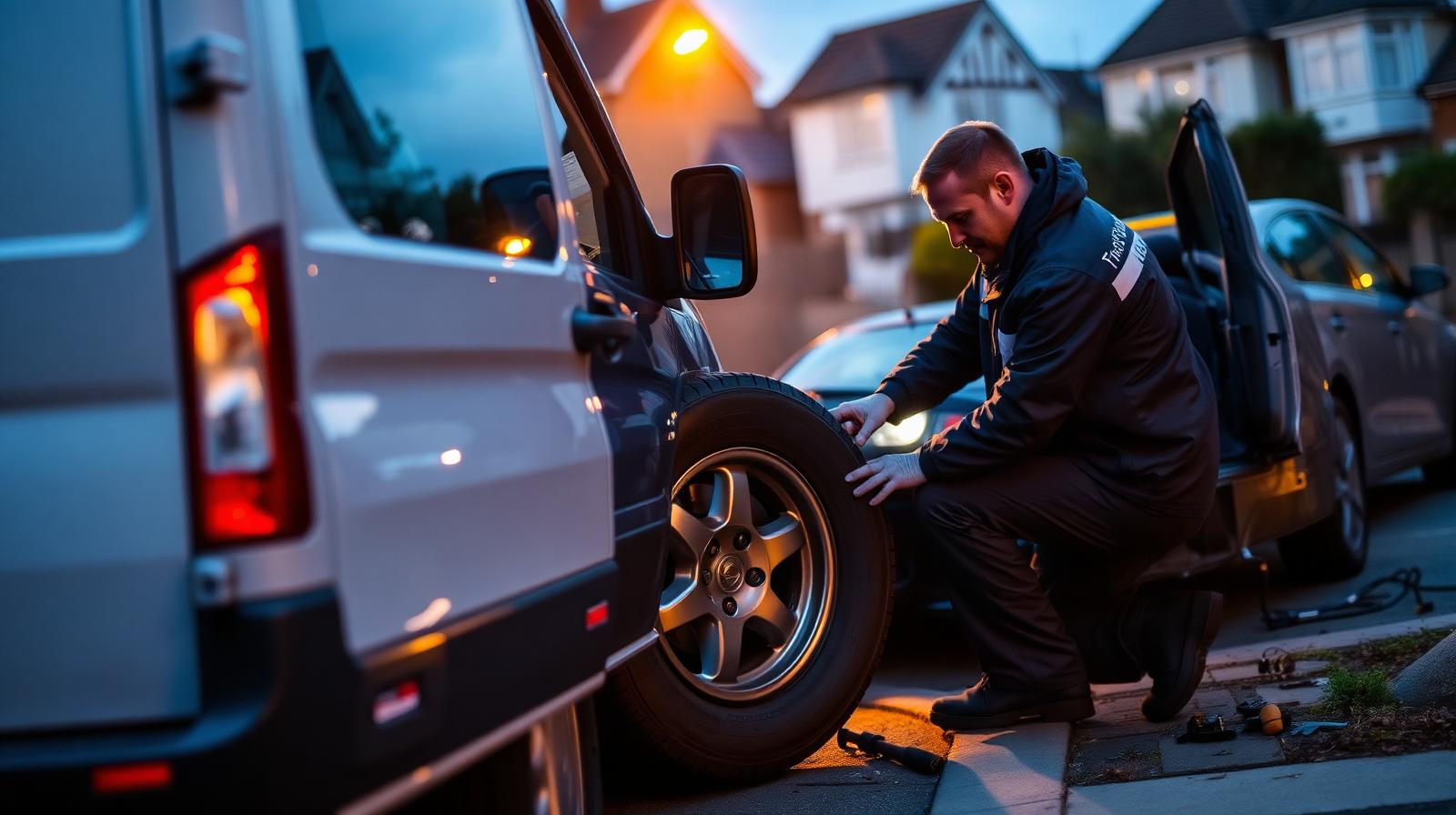
When to call a mobile tyre fitter vs recovery
Call a mobile tyre fitter when:
- The car is in a safe, accessible spot (kerbside, driveway, petrol station, car park).
- The damage is to the tyre only — wheel looks intact.
- You know the tyre size (printed on the sidewall, e.g. 225/45 R17 91W).
Call recovery (your insurer, breakdown cover or 999 on a smart motorway) when:
- You're in a live motorway lane or any unsafe position.
- The wheel is buckled, cracked or the car is sitting on the brake disc.
- Multiple tyres are damaged.
- There has been a collision.
How much does a flat tyre cost in London?
Real 2026 numbers from across our London network:
- Puncture repair (mobile, single plug): £35–£55
- Budget replacement tyre fitted at the roadside: £85–£130
- Mid-range premium (Michelin, Continental, Bridgestone) fitted: £150–£240
- Performance / SUV tyre fitted: £220–£420
- Run-flat replacement: add £40–£90 on top of equivalent standard tyre
- Out-of-hours surcharge (10pm–6am): typically £20–£40
Watch out for two London-specific scams: cash-only "roadside fitters" with no van branding who charge £300+ for a £90 tyre, and recovery operators who tow you to a partner garage that bills triple. Always ask for the total price before agreeing, and insist on a written or WhatsApp quote with the tyre brand and model named.
Average mobile callout price in London
The average all-in mobile tyre callout in London in 2026 is around £140 — that's the typical bill for one mid-range replacement tyre fitted at the kerbside during normal hours, including the callout, balancing, valve and disposal of the old tyre. Across the wider M25 the average drops to about £125 because labour competition is higher outside Zone 1–2.
By time of day and tyre choice, expect:
- Daytime, budget tyre: £95–£135 all-in
- Daytime, mid-range premium: £140–£200 all-in
- Daytime, performance / SUV / run-flat: £220–£420 all-in
- Night (10pm–6am), any tyre: add £20–£40
- Weekend / bank holiday: add £10–£25
- Inside Congestion Charge or ULEZ during charging hours: some operators add £15 (the van pays the charge, you pay it back)
A repair-only callout (no new tyre, just plugging a tread puncture) averages £45 in London, normally 20–30 minutes on site. If the fitter arrives and finds the damage is in the sidewall or shoulder, the job converts to a replacement and the repair fee is rolled into the new tyre price — you should never pay for both.
Anything quoted above £180 for a single standard tyre, or any "diagnostic fee" before the fitter has looked at the wheel, is a red flag. Walk away and call someone else.
How to read your tyre size (the number every fitter will ask for)
Before you call anyone, find the size printed on the sidewall of the tyre. It looks like a string of letters and numbers, for example:
225 / 45 R 17 91 W
Here's what each part means:
- 225 — tyre width in millimetres (tread to tread).
- 45 — profile / aspect ratio. Sidewall height as a percentage of the width. Lower = sportier, harsher ride.
- R — radial construction. Almost every modern car tyre is radial.
- 17 — wheel diameter in inches. Must match your alloy.
- 91 — load index. 91 = 615 kg per tyre. Never fit a lower load index than the original.
- W — speed rating. W = 168 mph. Common ratings: H (130), V (149), W (168), Y (186). Don't drop below the manufacturer's rating — insurance can void.
You may also see extra markings — they matter when ordering a replacement:
- XL or Reinforced — heavier-duty carcass, common on SUVs and EVs.
- RFT / ROF / EMT / ZP / SSR — run-flat. Replace like-for-like unless your car can run on standard tyres (check the handbook).
- M+S or three-peak-mountain snowflake — all-season or winter tyre.
- ★ / MO / N0 / AO / J / * — OE-approved fitments for BMW, Mercedes, Porsche, Audi, Jaguar etc. On these cars, fitting a non-OE tyre is legal but can affect ride and tyre warranty.
- DOT XXXXYYWW — date code. Last four digits = week and year of manufacture (e.g. 3823 = week 38 of 2023). Don't accept a "new" tyre older than 24 months.
Where to find the size
- Sidewall of the tyre itself — easiest if the tyre is intact. Use your phone torch.
- Driver's door jamb sticker — open the driver's door; a label on the B-pillar lists factory-recommended sizes and pressures.
- Inside the fuel filler flap — many European cars print pressures (and sometimes sizes) here.
- Owner's handbook — under "wheels and tyres".
- V5C log book — does NOT list tyre size; only the vehicle's plated weights.
If the tyre is shredded and unreadable, send your registration plate to the fitter — any reputable mobile operator can look up the OE size from the DVLA in seconds. Send the size of the other three wheels too if they differ (some cars run staggered front/rear setups, common on RWD BMWs and performance cars).
What else to send when you book
- Full postcode and a what3words or pin drop if you're roadside.
- Tyre size (e.g. 225/45 R17 91W) — and run-flat marking if applicable.
- How many tyres need replacing.
- Photo of the damage (helps the fitter bring the right kit — repair plug vs full replacement).
- Car make, model and year — confirms wheel locking-nut type.
- Whether you have the locking wheel-nut key in the car. No key = no wheel off. It usually lives in the glovebox, boot floor or with the spare.
Your legal duties as a UK driver
The law is short and strict. Each tyre must have at least 1.6 mm of tread depth across the central three-quarters of the tread and around the full circumference. Driving on a tyre below the limit, or with a visible cut, bulge or cord showing, is a £2,500 fine and 3 penalty points per tyre — that's £10,000 and a driving ban for one set. Insurance will also typically void a claim if illegal tyres are found at the scene.
If your TPMS warning light is on, you must investigate before driving further. A persistent TPMS fault is an MOT failure.
After the fitter leaves: the 24-hour checklist
- Re-check pressures cold the next morning — a new tyre can settle.
- Have the wheel alignment checked within a week if you hit a pothole; uneven wear starts within 500 miles.
- Keep the receipt and tyre details for your service history.
- If you suspect a pothole caused the damage, report it to TfL or your borough council within 14 days — you may be able to claim back the cost.
- Photograph the location, the pothole and the damage. No photos, no claim.
How to avoid your next flat
- Check pressures monthly — most petrol stations have free gauges, or buy a £15 digital one for the glovebox.
- Rotate front-to-back every 6,000 miles — front tyres on FWD cars wear roughly twice as fast.
- Replace in pairs on the same axle — mismatched grip levels destabilise braking and ABS.
- Buy from a fitter who balances on the wheel — a £5 weight saves a £400 set of bushes.
- Inspect after every kerb strike — look for bulges on the sidewall; they always become blowouts.
- Avoid the worst potholes — keep distance from the car in front so you can actually see road surface ahead.
Bottom line
A flat tyre in London is unpleasant but rarely an emergency if you handle the first minute correctly: slow down gently, reach a safe spot, get everyone behind a barrier, and call a properly-branded mobile fitter who'll quote the total cost up front. Don't keep driving on a deflated tyre, don't accept cash-only roadside deals, and don't ignore the TPMS light.
Tyrefly's mobile fitters operate across every London borough 24/7, with typical arrival inside the North & South Circular of 35–60 minutes. If you're stuck right now, send a WhatsApp with your postcode and tyre size from the sidewall — we'll quote in minutes and dispatch the nearest van.
Flat tyre in London FAQs
What should I do immediately after getting a flat tyre in London?
Don't brake hard. Ease off the accelerator, grip the wheel firmly, indicate and aim for a safe spot (hard shoulder, layby, petrol station or side street). Put hazards on, get everyone out behind a barrier, and call a mobile tyre fitter or recovery.
How much does a mobile tyre fitter cost in London?
Puncture repairs run £35–£55. Replacement tyres fitted at the roadside in London typically cost £85–£130 for budget tyres, £150–£240 for premium brands and £220–£420 for performance or SUV sizes. Out-of-hours work adds £20–£40.
Can I keep driving on a flat tyre?
Only if it's a genuine run-flat tyre (marked RFT, ROF, EMT, ZP or SSR), and only up to 50 miles at 50 mph. Standard tyres driven flat for more than 100–200 metres are destroyed and may damage the alloy and suspension.
Is a flat tyre an MOT failure?
Yes if tread depth drops below 1.6 mm across the central three-quarters of the tread, or if there are visible cuts, bulges or exposed cord. Each illegal tyre carries a £2,500 fine and 3 penalty points.
Need help right now?
Send your postcode and tyre size (e.g. 225/45 R17) and we'll dispatch the closest mobile fitter.
Get a mobile fitter →See also our area pages for London, Birmingham and Manchester.