Comparison · 10 min read
Budget vs Premium Tyres UK: Where Your £50 Extra Goes
Budget vs premium tyres UK-wide: "Are premium tyres worth it?" is one of the most asked questions in the UK tyre trade — and the honest answer is neither an unqualified yes nor a blanket no. What you get for the extra money varies by tyre size, driving style, mileage and weather. This is the plain-English breakdown so you can make the call for your own car.
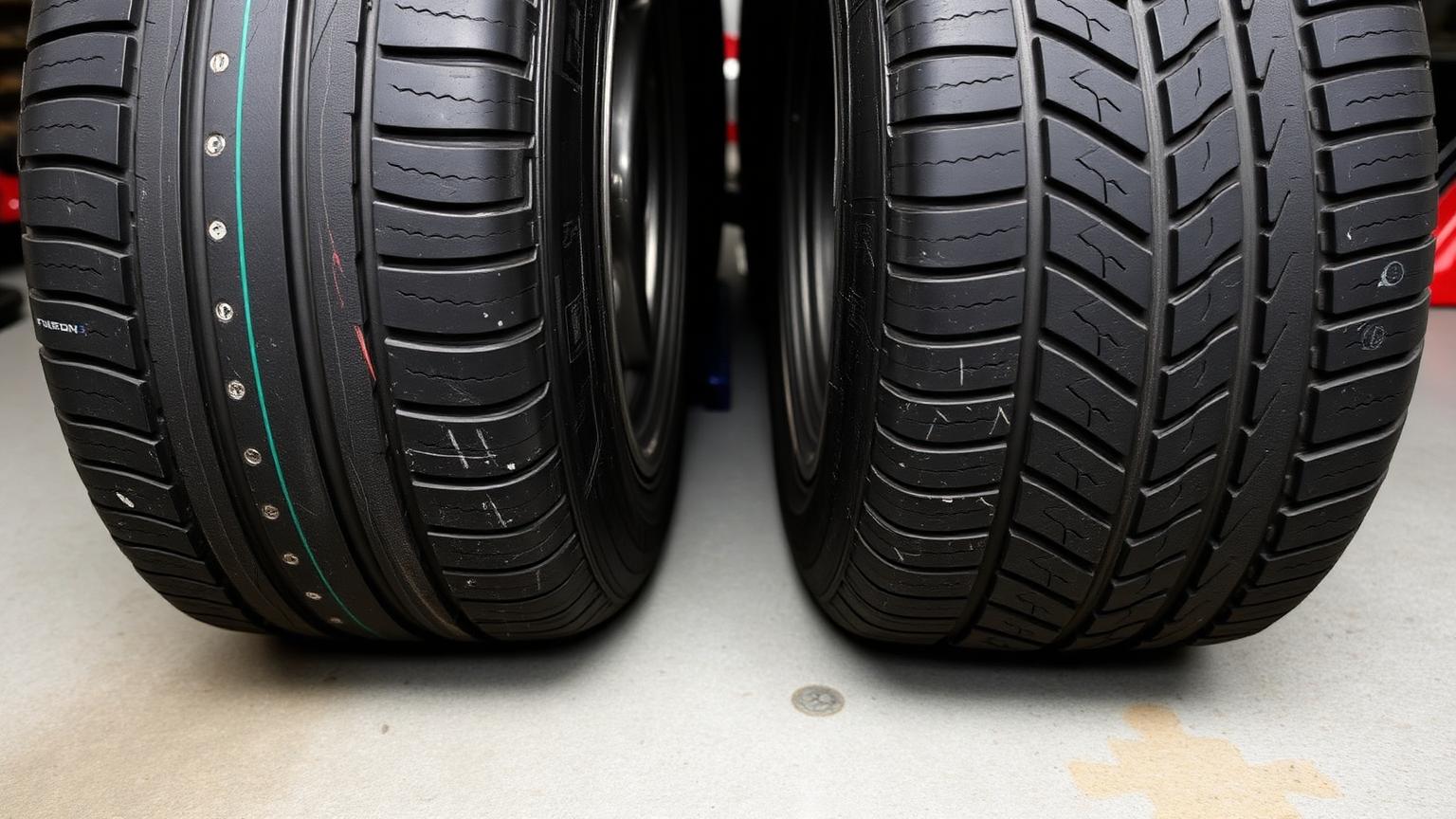
What defines each tier in 2026
- Budget (£45–£75 per tyre for 16-17"): Sailun, Landsail, Kumho, Nankang, Rovelo, Roadstone. Basic compound, functional wet grip, shorter tread life.
- Mid-range (£75–£120): Falken, Hankook, Toyo, Uniroyal, Vredestein, Yokohama. Solid performance, decent wet grip, competitive tread life. The sweet spot for most UK drivers.
- Premium (£120–£220): Michelin, Continental, Bridgestone, Goodyear, Pirelli. Advanced compounds, best-in-class wet grip, longest tread life on average, quietest ride.
Same size, same speed rating, same load index. The differences are in the compound and construction, not the numbers on the sidewall.
Flat tyre right now?Message a mobile fitter →What the EU tyre label tells you (and what it doesn't)
Every tyre sold in the UK has an EU tyre label rating three things:
- Fuel efficiency — rolling resistance rated A–E.
- Wet grip — braking performance rated A–E.
- External noise — dB level and A/B/C rating.
The wet grip figure is the most important. The difference between an A-rated and a C-rated tyre on the same car at 50 mph is roughly 6–8 metres of extra braking distance in the wet — one car length. That's the difference between stopping at a zebra crossing and hitting a pedestrian.
What the label doesn't tell you: dry braking, aquaplaning resistance, snow performance (unless the tyre carries the 3PMSF symbol), tread life, or handling character. That's what independent tests like Auto Express, What Car? and the ADAC winter tyre test are for.
Where premium tyres actually earn the extra money
1. Wet braking. Repeatedly tops the independent test tables. A Michelin CrossClimate or Continental PremiumContact can beat a budget tyre by 8–12 metres from 50 mph in the wet. On a rainy motorway that's not a small margin.
2. Tread life. Premium compounds routinely last 40,000–60,000 miles versus 20,000–30,000 for budgets. Over the life of the car this often makes the premium tyre cheaper per mile — the sticker price is misleading.
3. Noise. A quiet premium tyre at motorway speed can be 4–6 dB quieter than a noisy budget. That's a big difference — dB is a log scale.
Stuck on the roadside?Send us your postcode →4. Aquaplaning resistance. The tread pattern and channel design on premium tyres clears water faster. Matters on the M25 in a downpour.
5. Consistency at wear. A worn premium tyre performs closer to its new-tyre spec than a worn budget tyre. Wet grip drops off faster on cheaper compounds.
Where budget tyres are genuinely fine
Not every car needs the top tier. Reasonable use cases for a well-reviewed budget tyre:
- Second car doing very low mileage (under 4,000 miles/year).
- Older car near the end of its life where £200 of premium tyres doesn't make sense.
- Winter beater used only for short local journeys.
- Small-engined city car where absolute grip in extreme conditions is not going to be tested.
The key: read the EU wet grip rating. A budget tyre with a B-rated wet grip is a genuinely usable tyre. A budget tyre with an E-rated wet grip is a false economy — you'll save £30 upfront and cost yourself insurance excess after your first wet crash.
Nail in the tread?Book a mobile repair →The mid-range case (what most drivers should actually buy)
The mid-range tier is the honest sweet spot for most UK drivers. Falken, Hankook, Toyo, Vredestein and Yokohama sit within 3–5% of premium performance in independent tests, at 25–40% lower cost. They're the tyres that quietly appear at the top of magazine group tests as "best value" year after year.
For a family car doing 12,000 miles a year with a mix of motorway and urban driving, a mid-range like Falken ZE310 or Hankook Ventus Prime 4 gets you 90% of the premium experience for 70% of the price. That's usually the smart buy.
Flat tyre right now?Message a mobile fitter →The per-mile cost calculation
The sticker price hides the truer picture. On a 205/55 R16:
- Budget @ £60, lasts 25,000 miles = 0.24p per mile per tyre
- Mid-range @ £95, lasts 40,000 miles = 0.24p per mile per tyre
- Premium @ £140, lasts 55,000 miles = 0.25p per mile per tyre
Almost identical per-mile. The premium isn't more expensive over the life of the tyre — it's more expensive per replacement. So the choice becomes about ride, noise, wet-weather safety, and cashflow, not about total cost.
The specific case: high-performance and EVs
On a Golf R, Model 3 Performance, or M340i, budget tyres are a genuinely bad idea. High torque and high cornering loads shred cheap compounds fast, and the wet-grip gap becomes safety-critical at higher speeds. Stick to mid-range or premium on any performance car, and read the specific model tests — some "premium" tyres are still not right for a specific application (e.g. some mainstream Michelins are too soft for a hot hatch).
Stuck on the roadside?Send us your postcode →For EVs, load ratings matter more than tier. See our guide to tyre age and wear.
The verdict
- For most family cars in the UK: mid-range tyre from Falken, Hankook, Toyo, Vredestein, Yokohama.
- For high-mileage or motorway-heavy driving: premium pays back in life and safety.
- For second cars, low mileage, or older cars: budget with a B-rated wet grip minimum. Never E-rated.
- For performance cars or EVs: mid-range or premium only. Match to the model, not just the tier.
Frequently asked questions
Are Michelin tyres worth the extra money?
For high-mileage or safety-critical use, yes — premium tyres win on wet braking (often 6–12 metres shorter than budget) and last significantly longer. For low-mileage second cars, mid-range is usually the smarter buy.
What's the difference between budget and premium tyres?
Premium tyres use more advanced rubber compounds and tread designs. The results: shorter wet braking distance, longer tread life (40,000–60,000 miles vs 20,000–30,000), quieter cabin, better aquaplaning resistance.
Is it safe to buy budget tyres?
Budget tyres with a B-rated wet grip on the EU label are safe for normal use. Avoid anything E-rated on wet grip — the extra braking distance in the wet isn't worth the £30 saving.
What's the best mid-range tyre in the UK?
Falken ZE310, Hankook Ventus Prime 4, Toyo Proxes CF2, Vredestein Ultrac and Yokohama BluEarth all consistently score well in independent tests at 25–40% below premium prices.
Need help right now?
Send your postcode and tyre size (e.g. 225/45 R17) and we'll dispatch the closest mobile fitter.
Get a mobile fitter →Mobile tyre fitting in your area
Book a mobile tyre fitter